Implant, Bridge or Removable Denture? Comparing Three Options

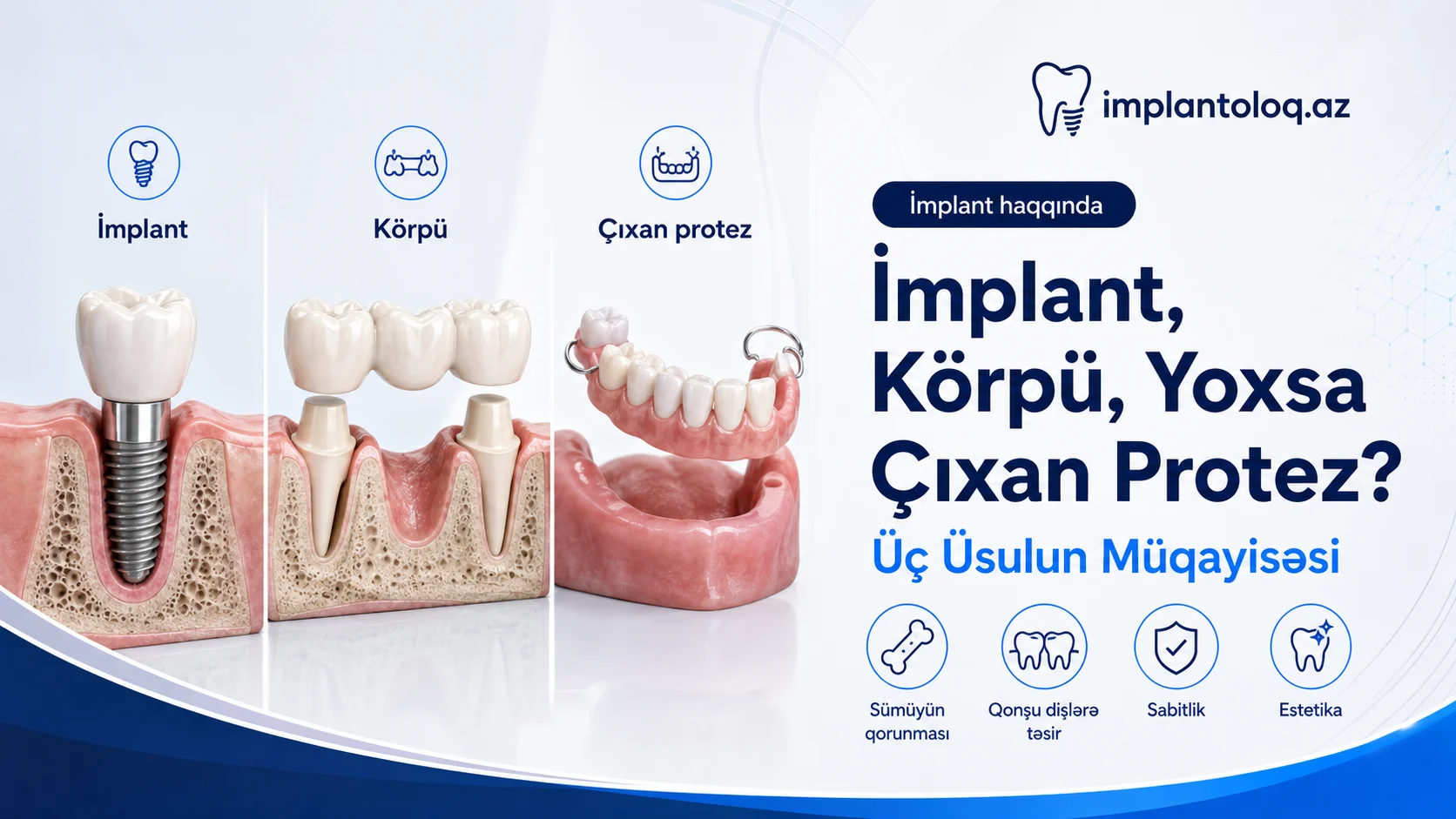
How can a missing tooth be replaced?
When a tooth is lost, the patient usually has three main options: an implant, a bridge and a removable denture. Each has its own indications, advantages and limitations. The right choice can only be made based on the condition of the mouth, the bone volume, the number of missing teeth and the patient's general health.
Below we compare the three options from a practical point of view.
1. Dental implant
An implant is a titanium screw placed in the jawbone. It replaces the root of the missing tooth, and an artificial tooth (crown) is attached on top.
Advantages:
- the healthy neighbouring teeth are not touched, so there is no need to grind them down;
- chewing forces are transferred to the bone, which slows down bone loss;
- with proper care it can be used for many years;
- it provides the appearance and function closest to a natural tooth.
Things to consider: it requires surgery, the bone needs time to heal and there must be enough bone volume. If bone is lacking, bone augmentation or a sinus lift may be needed first.
2. Dental bridge
A bridge uses the teeth on both sides of the gap as supports: they are ground down and a connected restoration is fixed on top of them.
Advantages:
- it is made relatively quickly;
- it does not require surgery;
- it can be used when there is a bone deficiency.
Things to consider: the main drawback is that healthy neighbouring teeth are ground down, and this step cannot be reversed. In addition, the bone under the missing tooth receives no load and keeps shrinking, so years later a gap may appear under the bridge.
3. Removable denture
A removable denture is a restoration the patient can put in and take out themselves. It is used when several teeth or all teeth have been lost.
Advantages:
- it is the most affordable solution;
- it does not require surgery;
- it can also be used when many teeth have been lost.
Things to consider: in terms of stability it is the weakest option. The denture can slip when speaking and eating, it can press on the palate and getting used to it takes time. Because the bone receives no load, bone loss continues, so the denture needs to be adjusted from time to time.
Which option in which situation?
In general terms:
- One missing tooth, healthy neighbouring teeth: an implant is often the most sensible choice, because the healthy teeth are left untouched.
- The neighbouring teeth need crowns anyway: a bridge can be a logical option.
- Several missing teeth: with an implant-supported bridge, a large area can be restored on a small number of implants.
- Complete tooth loss: fixed implant-supported solutions such as All-on-4 or All-on-6, or a removable denture stabilised by implants, are considered.
The long-term view
When choosing, it is important to look not only at the upfront cost but also at the long-term result. A bridge or removable denture offers a faster solution, but neither prevents bone loss, and over time they may need further treatment. An implant takes longer to prepare, but it is the only option that preserves the bone.
The best decision is made after an examination, a CBCT scan and a discussion with the doctor. Contact us to have your situation assessed and find the option that suits you.
This is general information. Your suitability, treatment time and cost are assessed individually during an examination.