All-on-4 and All-on-6: An Implant Solution for Complete Tooth Loss

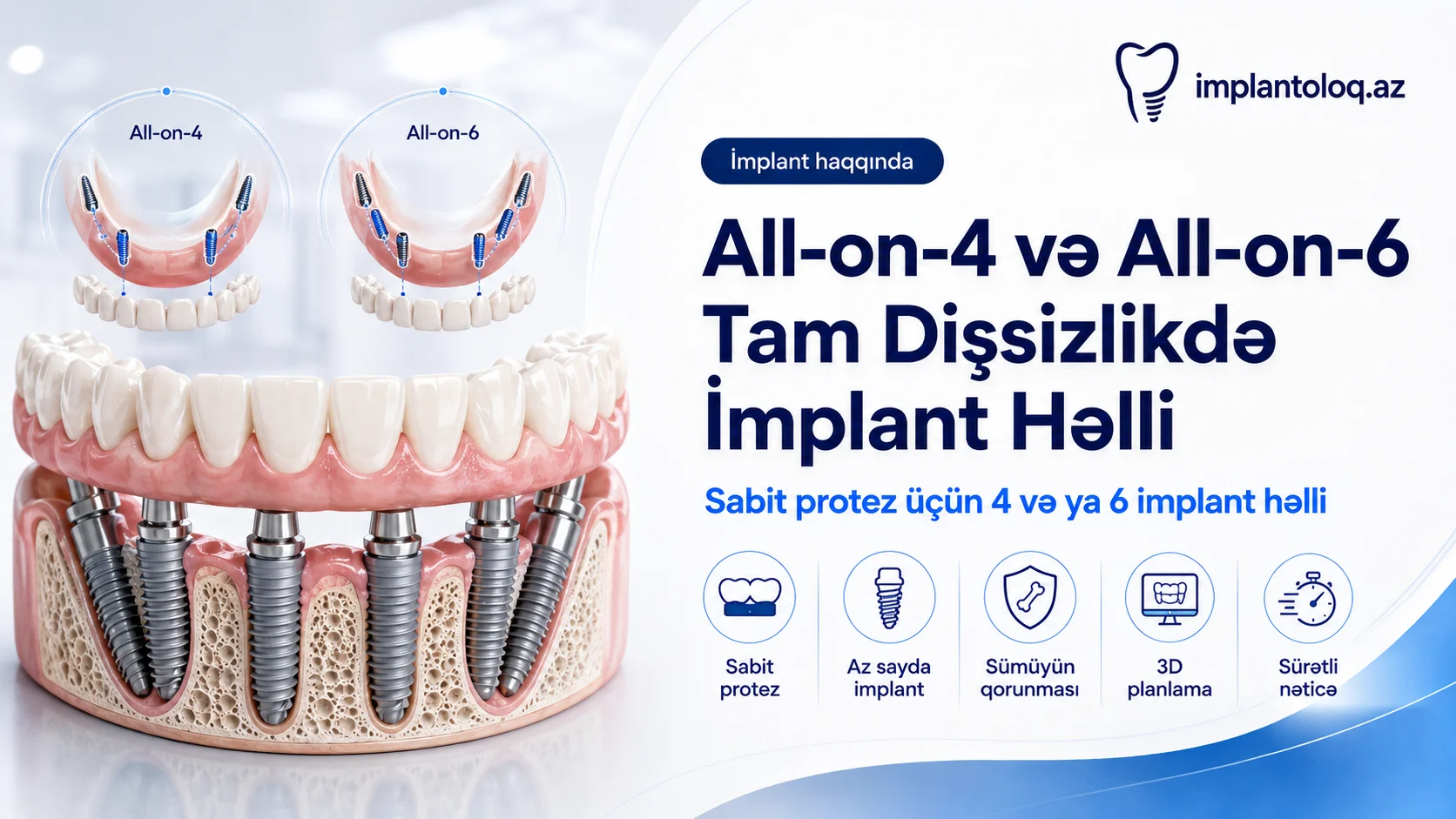
What are All-on-4 and All-on-6?
Complete tooth loss, meaning the loss of all teeth in one jaw, seriously affects both chewing and a person's daily life. For many years the main solution was a removable denture. Modern implantology offers a more stable alternative: restoring the whole jaw on a limited number of implants.
With the All-on-4 method one jaw is restored on 4 implants, and with All-on-6 on 6 implants. In both approaches a fixed prosthesis is attached to the implants. The patient does not take it out at night; it stays in the mouth permanently.
Main advantages of this method
- Stability: the prosthesis does not move and does not slip when you speak or chew.
- Less need to cover the palate: in many upper-jaw cases it is possible to avoid a design that covers the whole palate, which improves the sense of taste.
- Bone preservation: implants transfer chewing forces to the bone and slow down bone loss.
- Fewer implants: a separate implant is not needed for every missing tooth.
- Fast functional result: in suitable cases a temporary prosthesis can be fitted within a short time.
The difference between All-on-4 and All-on-6
The main difference is the number of implants and how the load is distributed. With All-on-6 the load is shared across more support points, which in some cases allows the restoration to last longer. All-on-4 can be a less invasive choice for patients with limited bone volume, because the back implants are placed at an angle to make the most of the available bone.
The choice depends on bone volume and density, chewing load, the relationship between the jaws and the patient's general health. This decision cannot be made without a CBCT scan.
What are the stages of treatment?
Examination and 3D diagnostics. A CBCT scan gives an accurate picture of the bone, the position of the nerve canal and the maxillary sinuses.
Digital planning. The number, position and angle of the implants are planned in advance. A surgical guide is made when needed.
Surgical stage. The implants are placed under local anaesthesia. If necessary, teeth that cannot be saved can be removed in the same session.
Temporary prosthesis. In suitable cases the patient receives a temporary fixed prosthesis within a short time, so they are not left without teeth during healing.
Healing and final prosthesis. Once osseointegration is complete, the permanent restoration is made and fixed in place.
Who is it for, and when is extra caution needed?
This method is intended for patients who have lost all the teeth in one jaw, or whose remaining teeth cannot be saved. It is also a real alternative for people who are unhappy with a removable denture and suffer from it slipping.
Even so, every patient is assessed individually. Uncontrolled diabetes, an active infection in the mouth, severe bone deficiency, heavy smoking and some systemic diseases can affect the plan. This is not necessarily a barrier, but an additional preparation stage is often needed.
Caring for the prosthesis
A fixed prosthesis needs daily cleaning, just like natural teeth. Special brushes, a water flosser and regular professional cleaning help the restoration last. The most reliable way to prevent inflammation around implants (peri-implantitis) is good hygiene and regular check-ups.
If you have questions about complete tooth loss and want to find out which solution suits you, contact us to book a consultation.
This is general information. Your suitability, treatment time and cost are assessed individually during an examination.