Immediate Implant in a Freshly Extracted Molar Socket: 5 Concepts for a Successful Result

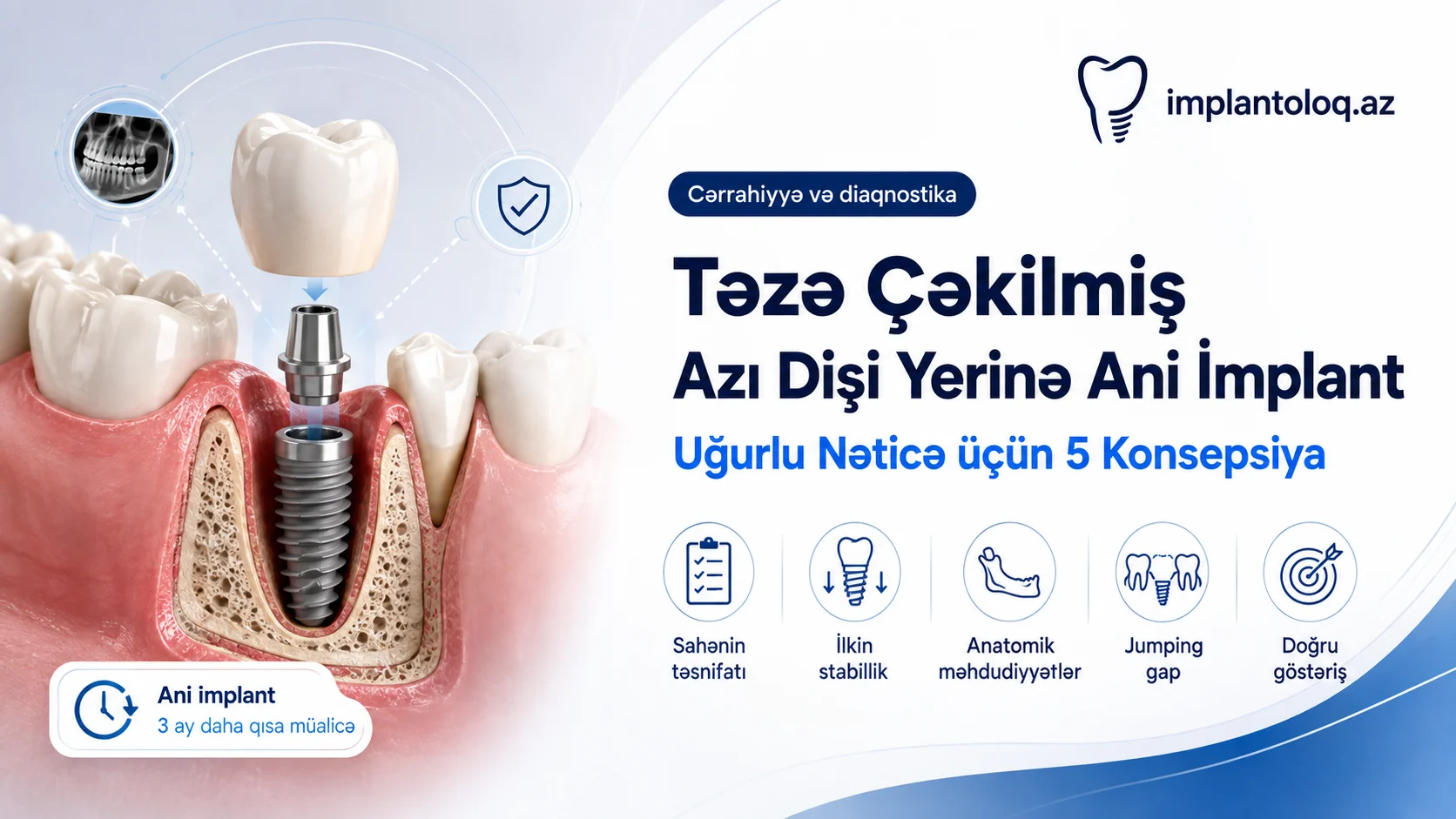
When should an implant be placed after a molar is extracted: on the same day, or after waiting a few months? This is one of the most debated questions in everyday practice, and both approaches have a scientific basis.
The patient is usually offered two options:
- Staged approach: the tooth is extracted, the socket is preserved (ridge preservation), there is a wait of 3–4 months, the implant is placed, and the permanent restoration is made 10 weeks later. Total treatment time: about 6 months.
- Immediate implant: the tooth is extracted and the implant is placed on the same day, and the permanent restoration is made 3 months later. Total treatment time: about 3 months.
The immediate approach shortens treatment by about three months. But is it as reliable as the staged approach? According to the scientific literature, yes, in properly selected cases (W. Becker and B. E. Becker 1995; Schwartz-Arad et al. 2000; Fugazzotto 2008; Cafiero et al. 2008). Everything hinges on the phrase "in properly selected cases". Below are 5 concepts that need to be kept under control for a successful result.
#1 Site classification
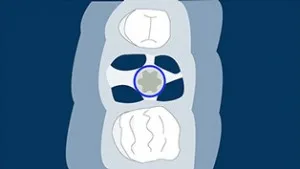
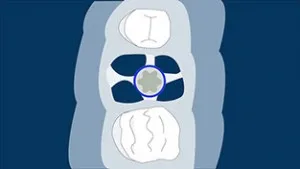
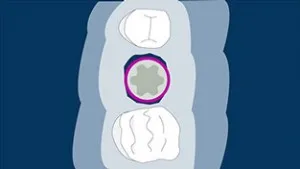
There are three types of sockets that help decide whether or not to place an implant (Smith and Tarnow 2013).
- Type A socket: the inter-radicular septum has enough bone to surround the implant completely, and primary stability is provided entirely by the septum.
- Type B socket: the septum surrounds the implant only partially. This is enough to reach the minimum torque value, but sometimes the implant has to be placed slightly more apically (3–5 mm) to achieve primary stability (Schwartz-Arad and Chaushu 1997a).
- Type C socket: the site is shaped like an hourglass, with the narrow part corresponding to the furcation. To place an immediate implant in such sites, a wide-diameter (7–9 mm) implant has to be "wedged" against the buccal and lingual walls; if this is not done correctly, the likelihood of bone resorption is very high. In practice, these sockets are the riskiest group for immediate implants and are only considered when primary stability can be achieved in the bone apical to the socket.
#2 Primary stability
This topic is both interesting and controversial. Some authors state that the minimum implant torque value (ITV) should be 15 N·cm and that the expected survival rate at this torque is about 86%; when the torque is above 30 N·cm, this figure rises to 90% (Walker et al. 2011).
However, torque does not always show the full picture. That is why, to get additional information about what is happening inside the bone at the moment the implant is placed, methods such as resonance frequency analysis (Osstell, ISQ) are used. Measuring how the ISQ value changes during healing makes it possible to track changes in stability objectively.
When a good torque value is combined with an acceptable ISQ value, that is, when the torque is above 30 N·cm and the ISQ is higher than 60, the likelihood of implant success is very high (Block 2011).
#3 Anatomical limitations
In the upper jaw, the main limitation is the maxillary sinus, while in the lower jaw the inferior alveolar nerve is not just a limitation but a structure that must not be touched.
Does this mean that an immediate implant is impossible in the upper jaw if the sinus is close to the remaining site after a molar is extracted? No. The literature describes immediate implant placement at molar sites performed together with sinus floor elevation using osteotomes (Artzi et al. 2003).
In the lower jaw this option is not possible: lateralisation of the inferior alveolar nerve cannot be justified for the sake of an immediate implant.
#4 What to do with the remaining gap?
The gap left between the implant and the socket walls (the jumping gap) is one of the most debated issues. Some authors argue that it is enough for the gap to fill with a blood clot alone (Schwartz-Arad and Chaushu 1997b; Wöhrle 1998; Tarnow and Chu 2011), while others recommend filling it with a bone substitute when the gap is larger than 2 mm (Akimoto et al. 1999; Wilson et al. 1998).
Because a flapless approach is used, filling the buccal gap should always be considered, as it helps preserve the dimensions of the socket (Araújo et al. 2011).
#5 When not to place an immediate implant
The list of things not to do is sometimes more important than the list of things to do, because it prevents serious problems.
The rule is simple: if part or all of the buccal wall is missing, do not place an immediate implant. In such cases a staged approach should be chosen: regeneration first, then delayed implant placement.
There is one more nuance: if significant bone remodelling occurs during healing, guided bone regeneration (GBR) may be needed later. This possibility should be discussed with the patient in advance.
Conclusion
Among the studies supporting immediate implants at molar extraction sites, the study by Fugazzotto is especially noteworthy: its long follow-up period and fairly large patient group (386 patients) make it a strong source of evidence.
Based on the results in the literature, it can be said that an immediate implant in a freshly extracted molar socket is a reliable and predictable treatment when the simple rules explained above are followed. The key to success is not the technique, but choosing the right case.
Whether an immediate implant is possible in your case can only be determined after a 3D scan and a clinical examination. For an examination and an appointment, you can contact us.
Source: Francisco Teixeira Barbosa, "5 Concepts to Achieve a Successful Immediate Implant Placement Into a Fresh Molar", Periospot. This article is an adapted translation.
This is general information. Your suitability, treatment time and cost are assessed individually during an examination.