When Is an Implant Placed After a Tooth Extraction?

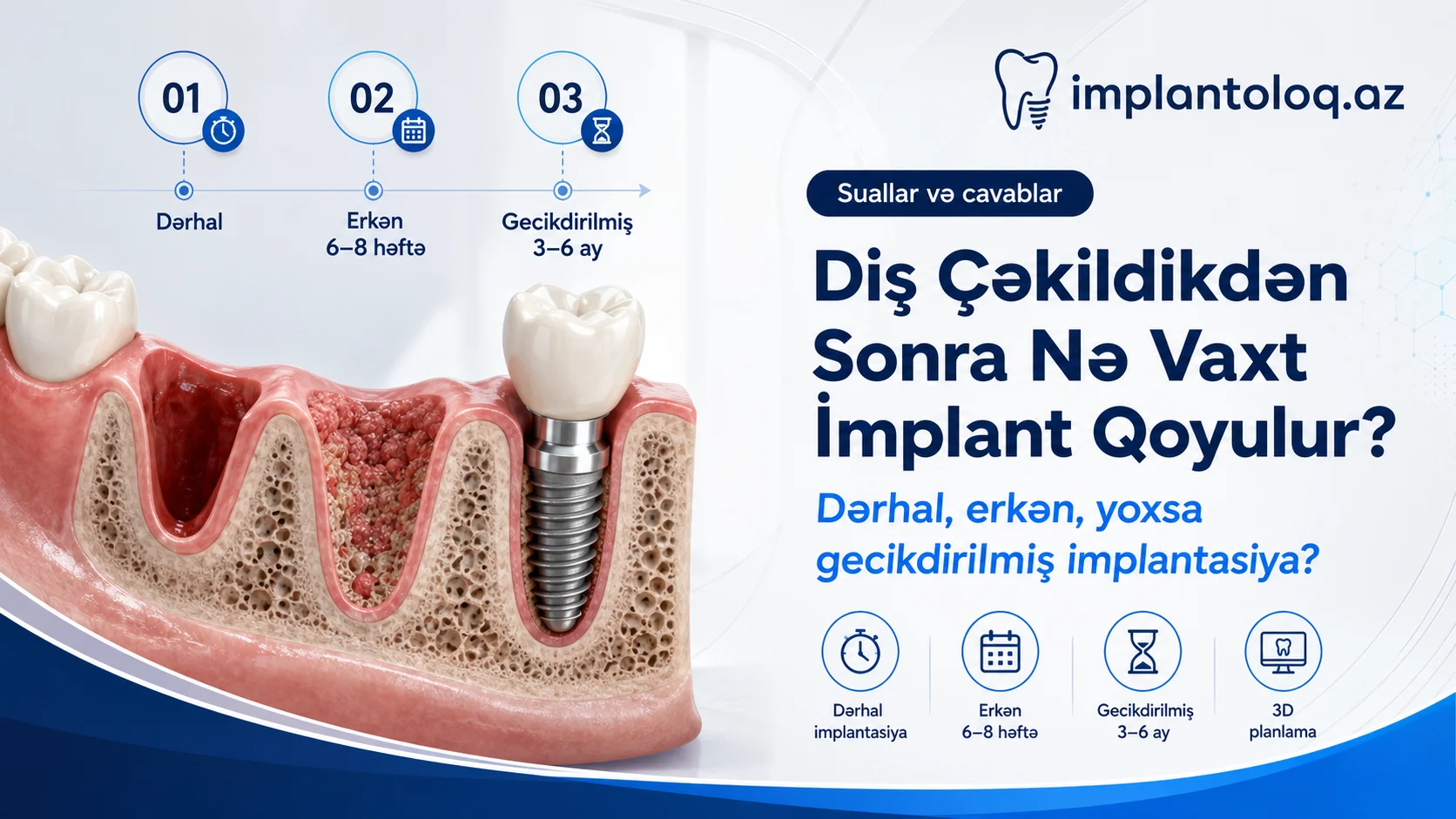
When is an implant placed after a tooth extraction?
This is one of the most common questions patients ask after a tooth is removed: when can the implant go in? The answer is not the same for everyone. Implant timing depends on why the tooth was removed, the condition of the bone, whether there is an infection and where the tooth sits in the mouth.
Modern implantology uses three main approaches: immediate, early and delayed implant placement.
Immediate implant placement
With this method the implant is placed into the empty socket in the same session as the extraction. The advantage is clear: fewer surgical procedures, a shorter overall treatment time and better preservation of the shape of the bone socket.
However, this method does not suit every case. For immediate placement there must be no active inflammation in the socket, the bone walls must be intact and the implant must achieve primary stability. If these conditions are not met, immediate placement increases the risk of failure.
Early implant placement
In this approach the implant is placed about 6–8 weeks after the extraction. During this time the soft tissue heals and any infection fully clears, while bone loss has not yet become serious.
Early placement is often considered a balanced choice: the risk of infection is lower and most of the bone volume is preserved.
Delayed implant placement
Here the bone is allowed to heal completely, usually over 3–6 months. This approach is chosen when there is a severe infection, when the bone walls are damaged or when additional bone grafting is needed.
Although delayed placement takes longer, in complex cases it is the most predictable option, because the implant is placed into fully healed, stable tissue.
Why is waiting too long not recommended?
After a tooth is lost, the jawbone in that area no longer receives chewing forces. Without load, the body treats this bone as "unnecessary" and resorption, that is bone loss, begins. The fastest loss happens in the first months.
As bone volume decreases, placing an implant becomes harder and additional procedures are often needed, such as bone grafting or a sinus lift. This increases both the treatment time and the overall cost.
In addition, when a gap is left empty for a long time, the neighbouring teeth can tilt towards it and the opposing tooth in the other jaw can over-erupt. As a result, the space needed for the implant gets smaller and the treatment plan becomes more complex.
Main factors that affect timing
- the reason for extraction: a fracture, decay or inflammation;
- whether there is an active infection in the socket;
- the integrity of the bone walls and the density of the bone;
- the position of the tooth: the front (aesthetic) zone or the back chewing zone;
- the patient's general health and smoking;
- the condition of the maxillary sinus in the upper jaw.
How is the decision made?
The right timing can only be determined after an examination and a 3D CBCT scan. The scan shows the bone volume and anatomy, which allows the implantologist to build an individual plan.
The most important advice is simple: do not put off the decision for long after a tooth is removed. Coming in early often means simpler, shorter and more predictable treatment. Contact us to book a consultation.
This is general information. Your suitability, treatment time and cost are assessed individually during an examination.