Why Act Quickly After Losing a Tooth? The Facts About Bone Resorption

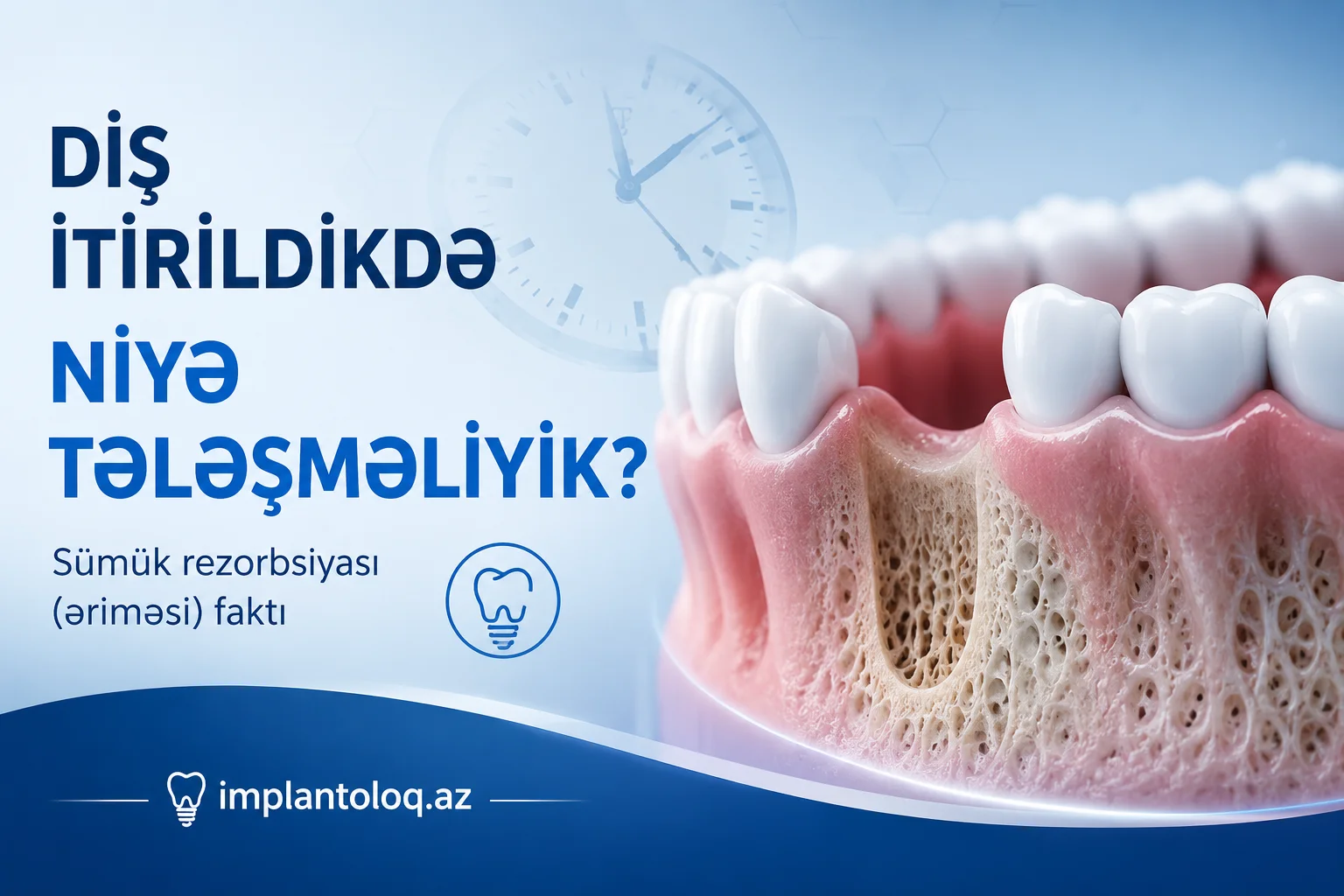
Why Act Quickly After Losing a Tooth? The Facts About Bone Resorption
Many people see tooth loss as a purely cosmetic problem. Yet when a missing tooth is left untreated for a long time, serious changes can take place in the jawbone. One of the most important problems in modern implantology is exactly this: bone resorption, or bone loss.
Many patients who visit an implantologist in Baku have put off treating a lost tooth for years, and as a result they later need additional bone procedures. After a tooth is removed, the bone in that area loses its former function and gradually begins to shrink in volume.
Here on implantoloq.az we explain in detail why bone resorbs after tooth loss and why implantology treats this as an important problem.
What Is Bone Resorption?
Bone resorption is the gradual shrinking of the jawbone after a tooth is lost. The tooth root passes a certain load and stimulus to the jawbone, which keeps the bone active. When the tooth is lost, that stimulus weakens and the bone slowly begins to resorb.
This process:
- Can develop slowly
- Can become more noticeable over the years
- Can cause both cosmetic and functional problems
In modern implantology, preserving bone volume is one of the key conditions for implant treatment.
Why Does Bone Start to Resorb After Tooth Loss?
Tissues in the human body that are not used can weaken over time. The jawbone works the same way: without a tooth root, the bone no longer receives its former functional load.
The most common causes:
- Going without teeth for a long time
- Gum disease
- Injuries
- Delayed implant treatment
- Improper use of a denture
Many people looking for an implantologist in Baku face exactly this problem of insufficient bone. That is why implantologists advise not to delay treatment after tooth loss.


What Problems Does Bone Loss Cause?
Bone resorption doesn't only make implant treatment harder. Over time it can also affect the appearance of the face and the way the mouth works.
As a result of bone loss:
- Placing an implant may become more difficult
- Additional bone procedures may be needed
- The shape of the face may change
- Chewing function may weaken
- Neighboring teeth may shift
One of the main goals of modern implantology is to preserve bone volume as early as possible.
Can an Implant Prevent Bone Loss?
Yes, implant treatment can help keep the bone functionally active. An implant passes a certain load to the jawbone and works in a way close to a natural tooth root.
In modern implantology, one of the advantages of an implant is precisely this bone-preserving effect. An experienced implantologist tries to prevent future bone problems through early implant treatment.
That is why, when a tooth is lost, it is better to get an implantologist's advice instead of waiting a long time.
How Fast Does Bone Loss Happen?
Many people don't consider tooth loss a serious problem for a long time. But modern implantology knows that bone loss can begin within the first months after a tooth is removed.
According to research:
- Bone loss may be faster in the first 6–12 months
- The longer you go without a tooth, the more bone volume is lost
- Over the years, implant treatment can become more complex
Some patients who come to an implantologist in Baku after waiting for years already need a bone grafting procedure.
Does Bone Loss Affect the Appearance of the Face?
Yes, bone resorption is not only a problem inside the mouth. If it continues for a long time, it can also affect the structure of the face.
Especially when several teeth are missing, you may notice:
- Sunken cheeks
- Less support for the lips
- A face that looks older
- A change in the shape of the jaw
These changes can become visible.
In modern implantology, one advantage of implant treatment is that it helps not only to restore the tooth but also to preserve the anatomy of the face.
Why Is an Early Implantologist Exam Important After Tooth Loss?
Many implantologists stress that an exam as early as possible after tooth loss is important. At an early stage:
- Bone volume is easier to preserve
- The chance of needing additional surgery is lower
- Implant treatment is easier to plan
- Healing may go faster
In modern implantology, the condition of the bone is assessed in detail with 3D imaging (CBCT). An experienced implantologist then prepares the most suitable treatment plan for the patient.
Is Bone Grafting Always Necessary?
Not every patient needs bone grafting. If tooth loss is treated early, in many cases additional procedures may not be needed.
But when bone loss has already reached a serious level, the following may be used:
- Sinus lift
- Bone graft material
- Regenerative procedures
The choice depends on the individual situation.
That is why timely diagnosis is considered very important in modern implantology. Putting off an implantologist's consultation can later increase both the length of treatment and the number of procedures.
How Long Has Bone Resorption Been Known?
The loss of jawbone after tooth loss is a topic dentistry has studied for many years. In the past, people believed tooth loss only caused chewing problems. With the development of modern implantology it became clear that once a tooth root is lost, the bone also gradually starts to lose its function.
Today implantologists consider bone resorption one of the most important problems in implant treatment. Going without teeth for a long time in particular can make future implant procedures more complex.
Does Bone Loss Happen at the Same Rate in Everyone?
No, bone resorption can progress at different rates in different people. The process can be linked to factors such as:
- Age
- General health
- Smoking
- Gum disease
- Oral hygiene
Each of these can influence how fast the process goes.
In some people bone loss is faster. Especially in people with gum problems, bone loss can become more severe.
In some patients who visit an implantologist in Baku, treatment of a lost tooth was put off for years, so they need additional bone procedures.
Does a Missing Tooth Affect the Other Teeth?
Yes, tooth loss is not limited to one area. Gaps that stay empty for a long time can also affect the condition of neighboring teeth.
In this case:
- Neighboring teeth may move toward the gap
- The alignment of the teeth may be disturbed
- The chewing balance may change
- Extra strain may be placed on the jaw joints
In modern implantology, one of the goals of implant treatment is to keep the mouth in balance. An experienced implantologist tries to treat tooth loss at an early stage.
How Does Bone Resorption Affect Appearance?
Teeth and bone structure are an important part of facial anatomy. When bone loss continues for a long time, changes in the appearance of the face can appear.
The most common changes:
- Sunken areas in the cheeks
- Less support for the lips
- A face that looks older
- A change in the jawline
That is why, in modern implantology, implant treatment helps preserve not only the function of the teeth but also appearance.
How Is Bone Preserved in Modern Implantology?
Today, implantology uses various technologies to preserve bone. Modern implantologists use methods such as:
- Early implant planning
- Bone grafting procedures
- Sinus lift surgery
- PRF and plasma technology
- Digital planning
The method is chosen for each case.
These technologies help preserve bone volume and make implant treatment more successful.
As implantology services develop in Azerbaijan, interest in modern, bone-preserving implant procedures has also started to grow.
Can Bone Grafting Fully Solve the Problem?
Modern implantology uses various bone augmentation methods to solve the problem of insufficient bone. These can include bone graft material, regenerative materials and, in some cases, bone transplantation.
With proper planning, an experienced implantologist can successfully restore missing bone in many cases. However, the result can vary depending on:
- The degree of bone loss
- The patient's general health
- Oral hygiene
- The technologies used
So the outcome differs from patient to patient.
The main goal of modern implantology is to restore bone volume as naturally as possible and create stable support for the implant.
Can Bone Loss Be Prevented?
Yes, bone resorption can be prevented to a certain extent. The most important factor is not to put off treating tooth loss for a long time.
Implantologists mainly consider these measures important:
- Early implant treatment
- Maintaining good oral hygiene
- Timely treatment of gum disease
- Regular dental check-ups
All of these help protect the bone.
Because an implant puts functional load on the jawbone, it can help keep the bone active. That is why modern implantology also regards implant treatment as a bone-preserving method.
However, after many years without teeth, it can be harder to stop bone loss completely. That is why it is important not to delay an implantologist's consultation.
What Is the Implantologist's Role?
In modern implantology, an implantologist is not just a doctor who places implants. They are a specialist who analyzes the bone, assesses future risks and prepares an individual treatment plan.
The implantologist:
- Assesses bone volume
- Analyzes the 3D scan
- Plans a suitable site for the implant
- Performs bone grafting procedures when needed
- Plans the aesthetic and functional result together
The implantologist's experience is especially important in patients with bone resorption. Even with modern technology, proper planning plays the key role.
How Are Specialists in This Field Developing in Baku?
In recent years, interest in implantology in Azerbaijan has grown considerably. Clinics in Baku that offer implantology services in particular have started to pay more attention to modern technology and international training programs.
Modern implantologists:
- Attend international courses
- Learn digital implantology systems
- Work with Piezo and plasma technologies
- Gain experience in aesthetic implantology
As a result of this progress, more modern approaches to implantology have begun to take shape in Baku. Patients now want not just an implant, but a long-lasting and aesthetic result.
This is general information. Your suitability, treatment time and cost are assessed individually during an examination.