What Determines the Price of a Dental Implant? An Implantologist Explains

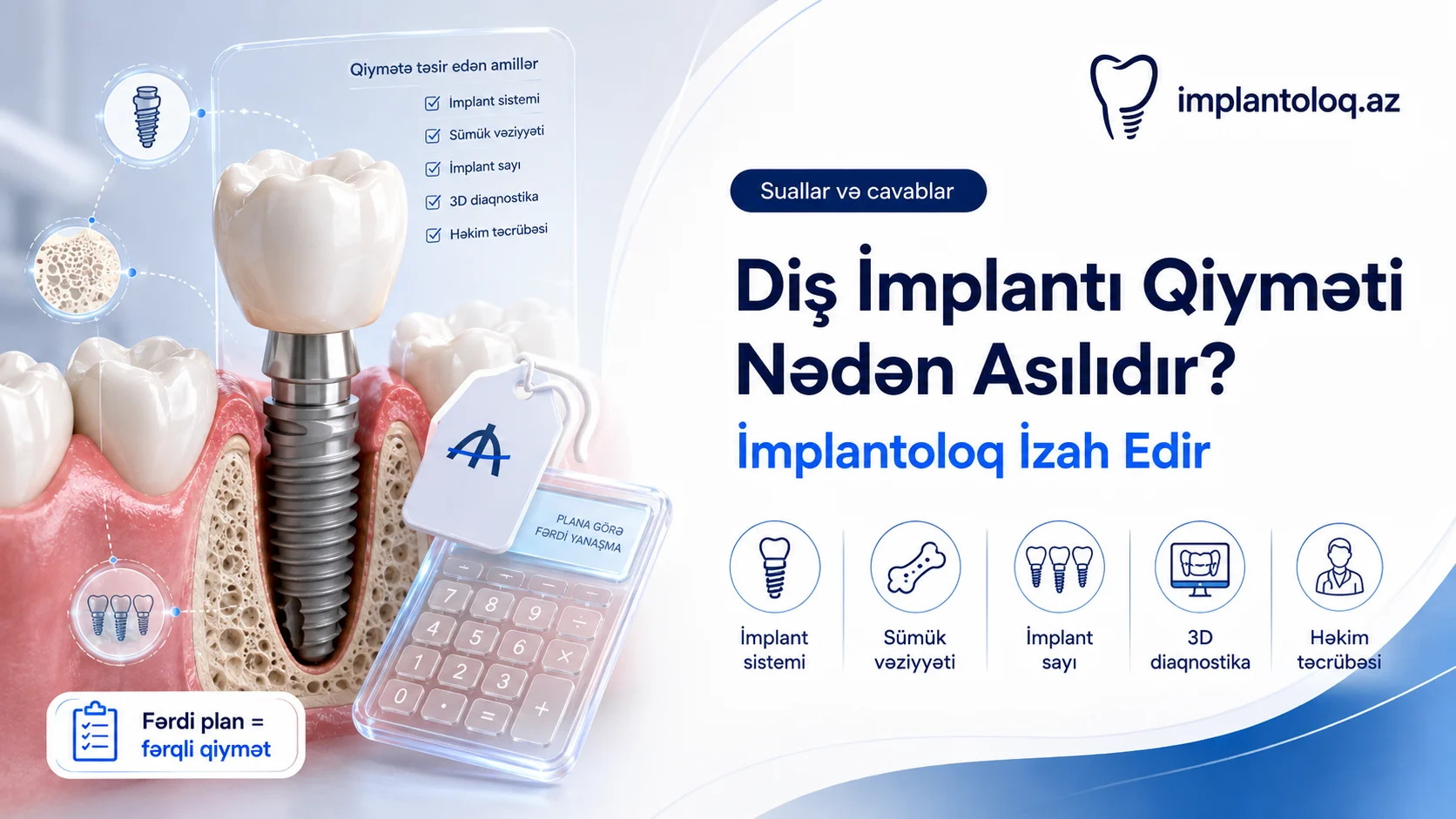
What determines the price of a dental implant?
One of the most common questions from patients considering a dental implant is about price. It is a perfectly natural question: implant treatment is a long-term choice, and patients want to know what they are paying for. However, it would not be right to express the price of an implant as a single number, because every mouth is different and every treatment plan is built individually.
Below we list the main factors that make up the cost of implant treatment. Knowing these factors helps patients understand the proposed plan better and compare different offers properly.
1. The implant system used
Implant systems differ by manufacturer, quality of the titanium alloy, surface treatment technology and history of scientific research. Systems backed by many years of clinical studies usually cost more, but in return their prognosis for integration with bone (osseointegration) is better understood.
Another important point is the availability of spare parts. With well-known systems, if the prosthetic part needs to be replaced years later, finding a compatible component is easy. With unknown systems, or systems that may leave the market, this can become a problem in the future.
2. Bone condition and additional surgical stages
Placing an implant requires enough bone volume. If the tooth was lost a long time ago, the bone may have shrunk (resorption). In such cases additional procedures may be needed before the implant or at the same time:
- bone grafting (augmentation);
- a sinus lift in the upper jaw;
- procedures to restore gum tissue.
These stages require separate materials and additional surgical work, so they affect the overall cost. This is why the same number of implants can mean a completely different plan and a different cost for two different patients.
3. Number of implants and the prosthetic solution
Restoring a single tooth is not the same as restoring a fully toothless jaw. For one missing tooth, a single implant with one crown on top is enough. When several teeth are lost, an implant-supported bridge can be planned, which means the number of implants can be smaller than the number of missing teeth.
For complete tooth loss, solutions such as All-on-4 or All-on-6 can be used. Here the whole jaw is restored on a limited number of implants. The material of the prosthesis (acrylic, zirconia or metal-ceramic) also directly affects the final cost.
4. Diagnostics and digital planning
In modern implantology, treatment starts with a 3D CT scan (CBCT). The scan shows exactly the volume and density of the bone and the position of the nerve canal and the sinuses. In some cases a surgical guide is also made, which allows the implant to be placed at the planned angle and depth.
These stages add cost to the plan, but they also improve the prognosis of the surgery and reduce the likelihood of unexpected situations.
5. The doctor's experience and the clinic's capabilities
The result of implant treatment depends to a large extent on planning and surgical execution. An experienced implantologist can manage complex cases more predictably, such as bone deficiency, anatomical limitations or restoration in the aesthetic zone. Sterile conditions, modern equipment and a professional team are also part of the cost of the service.
The cheapest offer is not always the best value
When comparing implant prices, look not only at the number but also at what the offer includes. Some offers cover only the implant itself, while the prosthetic stage is charged separately. For clarity, it is worth asking:
- does the offer include the implant, abutment and crown?
- which implant system will be used?
- if bone grafting or a sinus lift is needed, is it charged separately?
- are the CT scan and planning included?
- what are the warranty terms for the system?
In the long run, treatment that is properly planned and carried out with quality materials is better value, because it reduces the likelihood of repeat intervention.
How can you find out the exact price?
An individual treatment plan and the exact cost can only be determined after an examination and a CT scan. During the examination the bone condition is assessed, the necessary stages are identified, and the patient is given a step-by-step plan.
If you have questions or would like to book an examination, you can contact us by phone. We will give you detailed information about your plan and the estimated cost.
This is general information. Your suitability, treatment time and cost are assessed individually during an examination.